Case study · demonstration project
Quince & Tone: a bakery-café website its owner keeps up to date
Quince & Tone is an imagined bakery-café in Sololaki, old Tbilisi. The business is fictional; the website is real and working. It was built the way a client project would be, to show what Showcase Studio makes and how a café would run it day to day.
The problem
- Guests read Georgian or English, mostly on a phone at the table.
- The menu changes during the day: khachapuri sells out, quince comes off the stove at four.
- The owner has no time to manage a website, and no wish to learn one.
- Guests ask about allergens every day, so the answers have to be clear.
What a guest does
- Walks past and checks on a phone whether it is open now, and until when.
- Sits down, scans the table’s QR code and reads the menu in Georgian or English.
- Filters out an allergen, opens a dish for the story behind it, sees what has sold out.
- Finds the address and the way in without hunting for it.
What was built
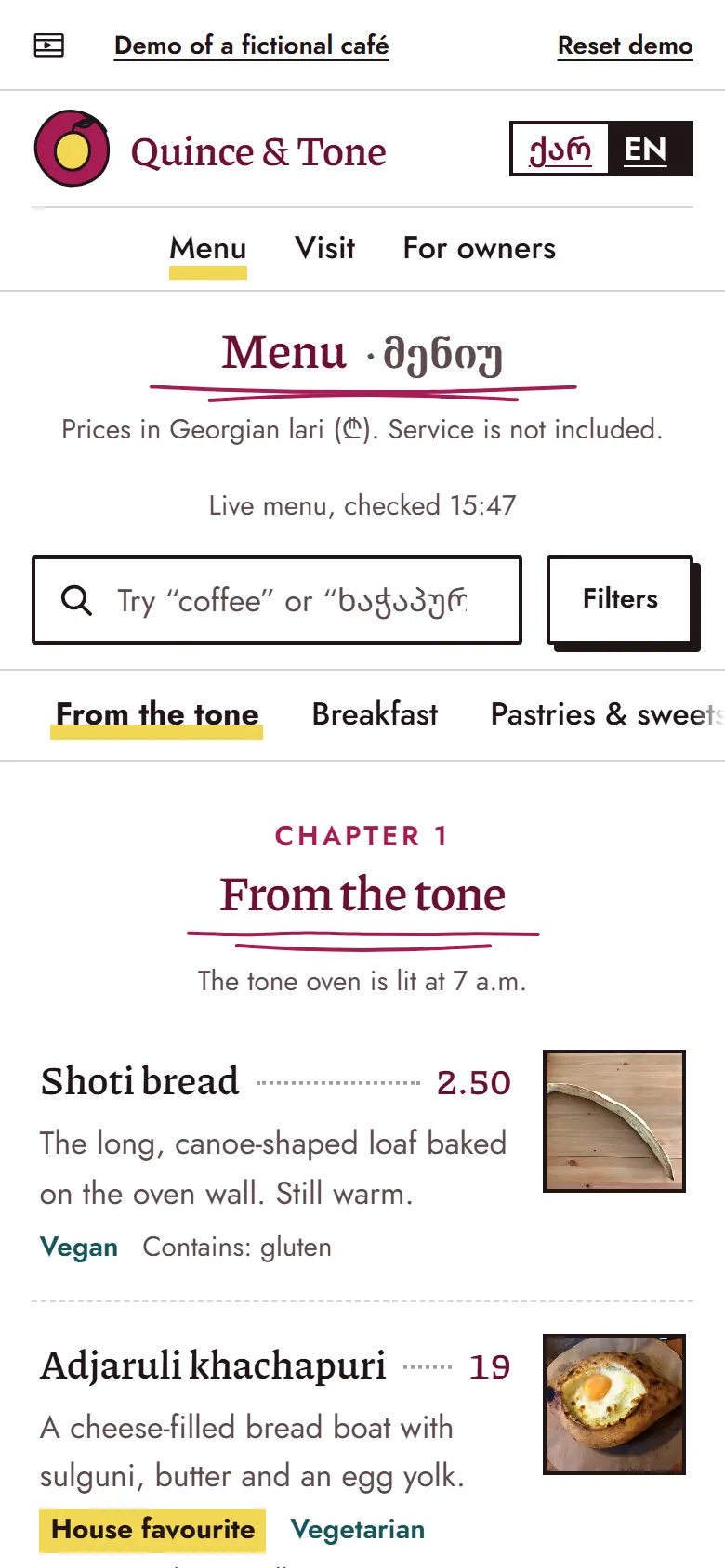
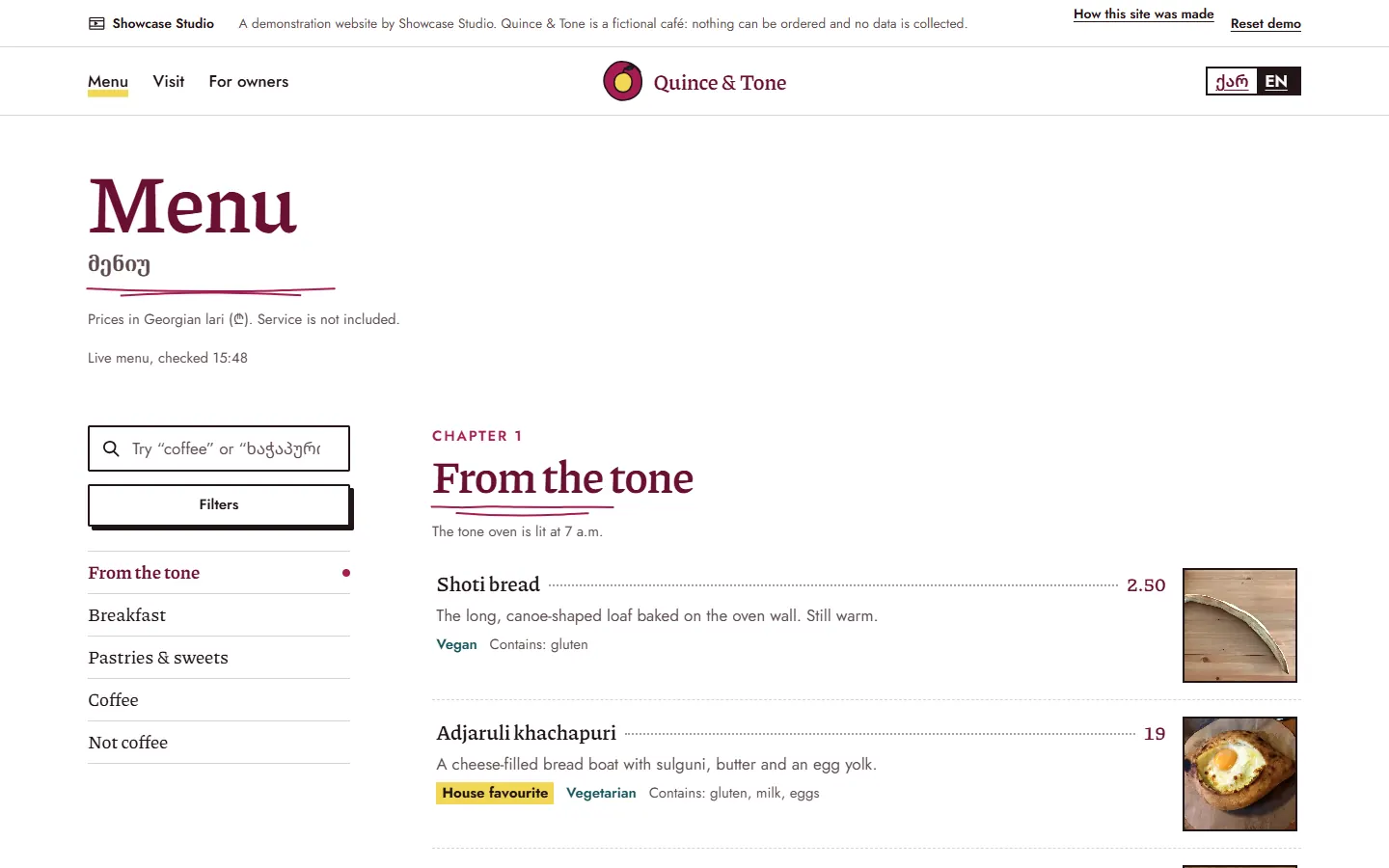
A bilingual QR menu
Search in either language, filter by diet or allergen, and see what has sold out. Each table’s printed QR code opens the menu with that table’s number.
Open the menu →A home page that answers the first questions
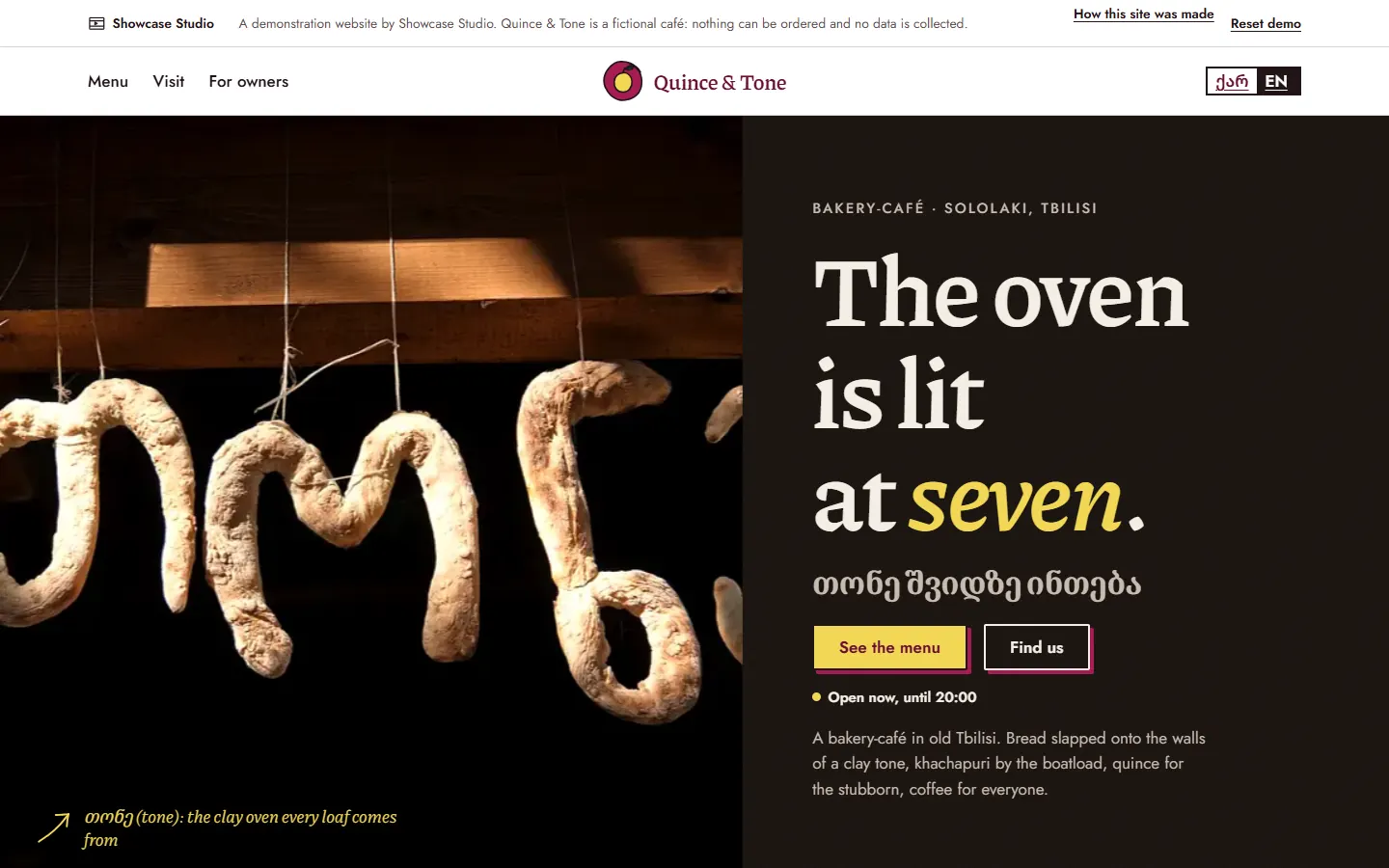
Open now or not, today’s hours, the address and the way in, without scrolling past a slideshow.
Open the home page →Editing without a new account
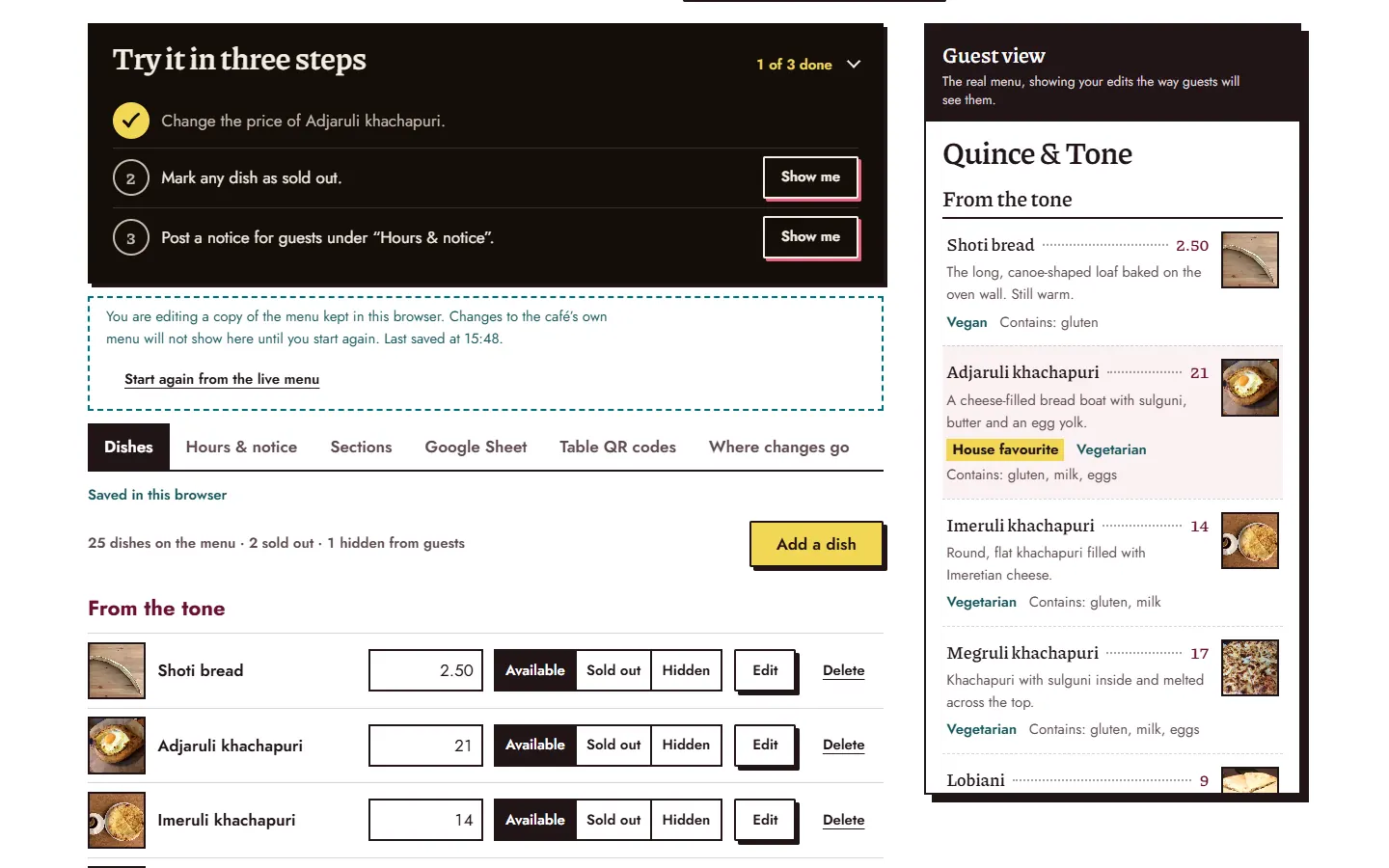
The menu is a Google Sheet. Change a price on a phone and guests see it on their next visit. The demonstration’s editor lets you feel this without a sheet.
Try the editor →Still there when the connection is not
If Google cannot be reached, guests see the last menu that loaded, or the printed one, with an honest note about how fresh it is.
Design principles
A day as the structure
The home page follows the bakery’s day, from the oven lit at seven to quince at four, so the story and the opening hours are the same thing.
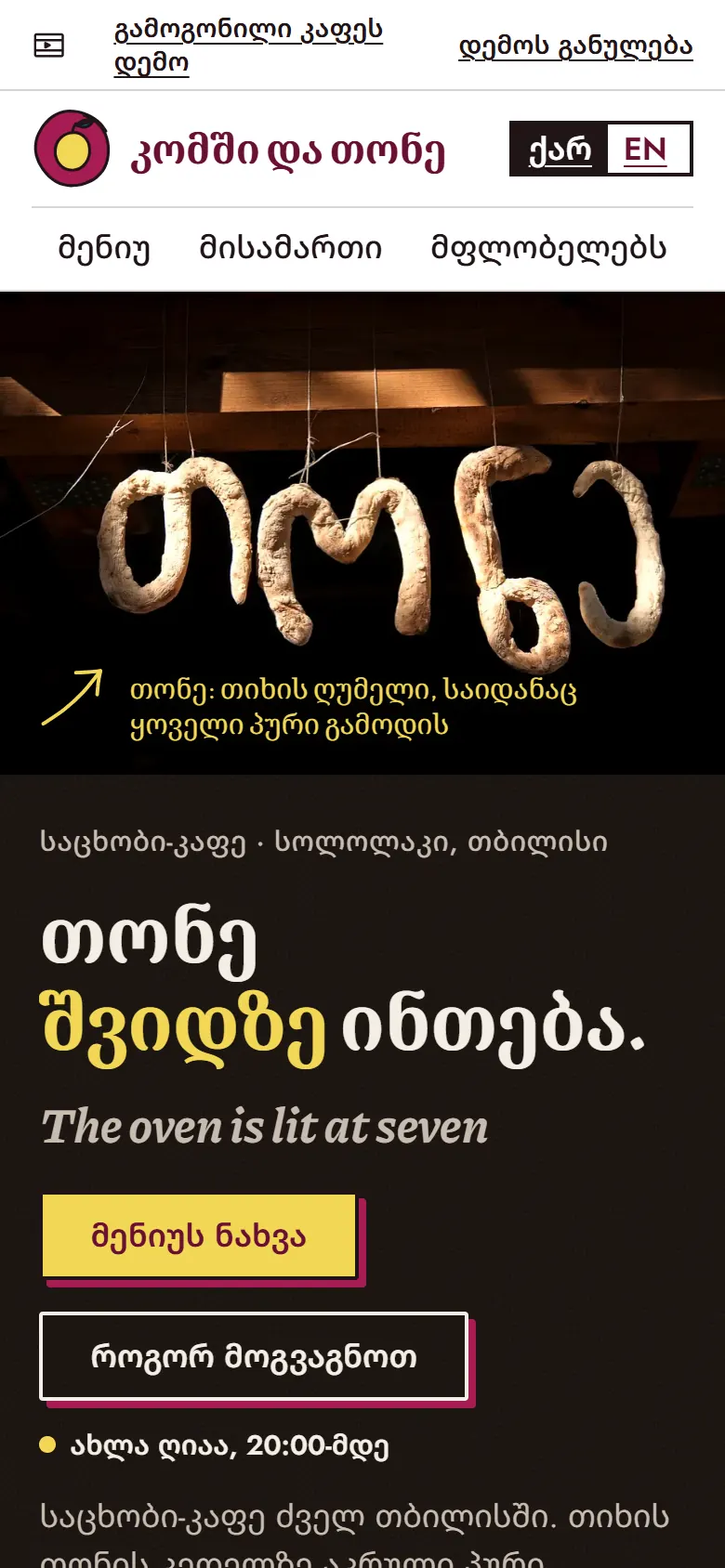
Georgian letters as images
The word თონე, spelled in dough, is the first thing you see. Mkhedruli letters are the only ornament; there is no clip art.
Two scripts as equals
Each language has its own serif for headings and its own sans for reading, chosen to sit side by side at the same weight.
One light for every photograph
Every photograph is graded with the same warm recipe, so pictures from different sources read as one place.
Ink only where it matters
A hand-drawn line marks a time, a price, the way in. Nowhere else.
Motion that settles
Things arrive once and then keep still. Anyone whose device asks for less motion gets none.
The work
Included, optional, demonstration only
Included
- Every page in Georgian and English
- QR menu with search, diet and allergen filters, sold out today
- Printable table cards with QR codes
- Menu edited in a Google Sheet
- Open-now status and opening hours
- Last menu kept for weak connections
- Keyboard and screen reader support, reduced motion
- No cookies, no tracking, free hosting
Optional, quoted separately
- Online ordering and payment
- Table booking
- Opening hours and notices edited in the same sheet (planned)
- A private owner page with log-in, roles and version history (designed, not built)
Demonstration only
- The in-browser editor: on a real website, the Google Sheet is the editor
- Edits kept in your browser, and “Reset demo”
- The café itself, its address and its phone numbers
What a real project needs
- Your menu, your photographs and the right to use them.
- A Google Sheet in your own Google account, which the studio sets up with you.
- Your website address, registered in your name.
- A decision on extras: online ordering, table booking, or editing hours and notices yourself (planned, not yet built).
- Time for a short lesson when the website is handed over.
Under the hood
Static pages served from Cloudflare’s network, a strict content security policy, no cookies, and images sized for each screen. Automated tests cover the menu rules, the guest and owner journeys on a phone and a computer, and accessibility checks on every page.